Two cars can list a continuously variable transmission and still use very different hardware. That matters when you are comparing driving feel, reading reliability discussions or asking a shop what service is required.
The initials describe a result—varying the relationship between engine speed and road speed without a conventional sequence of fixed-ratio shifts—more clearly than they describe every possible mechanism. Start with the exact powertrain, not a blanket opinion about three letters.
A conventional CVT often uses pulleys and a belt
Nissan’s Xtronic explanation describes adjustable pulleys connected by a steel belt. Changing the effective diameters where the belt runs varies the ratio. Other CVT designs may use a chain, so even this category is not one identical piece of hardware.
The result can feel different from an automatic that steps through distinct gears. On a test drive, pay attention to how the car responds while merging or climbing a hill, rather than judging it only during a short loop around the dealership.
A power-split hybrid e-CVT works differently
Toyota’s description of Hybrid Synergy Drive explains a planetary-gear power-split device working with the engine, motor and generator. It produces continuously variable operation without the conventional belt-and-pulley arrangement described above.
This is why a discussion of one belt-driven transmission does not automatically apply to a Toyota hybrid power-split system. The shared letters do not establish shared parts or failure modes. Hybrid systems also vary, so do not extend the Toyota explanation to every car advertised with an e-CVT.
A launch gear is another separate idea
Toyota also makes a Direct Shift-CVT with a launch gear. Toyota describes using gear drive for starting off and a belt for the continuously variable portion. That design should not be confused with its power-split hybrid e-CVT.
If a seller says a transmission “has a real first gear,” ask which transmission and engine the vehicle actually has. Sales descriptions, forum shorthand and different model-year options can get mixed together surprisingly easily. The original specifications are a better reference.
Evaluate the actual vehicle and its service requirements
No transmission name guarantees reliability or proves a vehicle is a bad purchase. For a used car, check the maintenance history, model-specific service information and condition during an independent inspection. Ask about any warning, shudder, leak or delayed response rather than accepting it as normal solely because the car has a CVT.
For maintenance, use the fluid specification and schedule for that exact powertrain. Do not assume a service recommendation for a gasoline version applies to the hybrid version with the same model name. Understanding the hardware helps you ask better questions; the vehicle’s own instructions should supply the service answer.
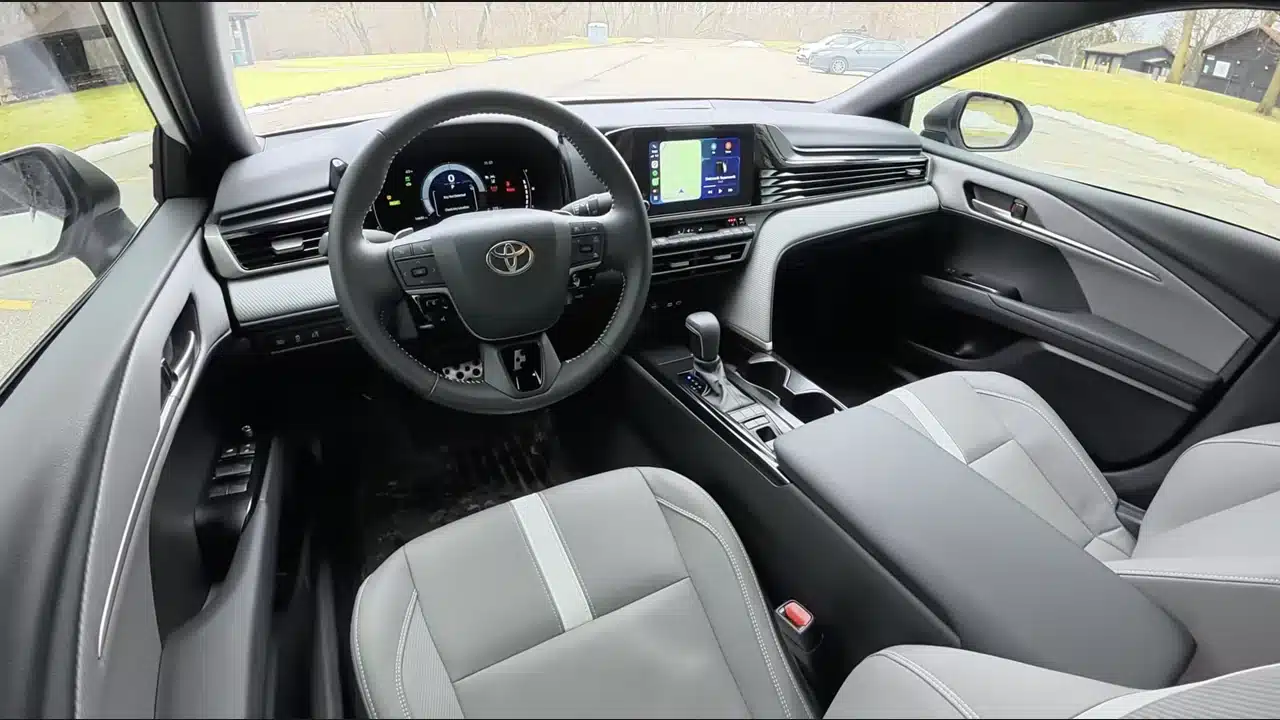
Illustrative Toyota Camry cabin image from Travis / yoopercharged’s owner-review video, supplied by Tim Esterdahl. No transmission components are visible.
New to hybrid ownership? See why a charged hybrid can still have a dead 12-volt battery.