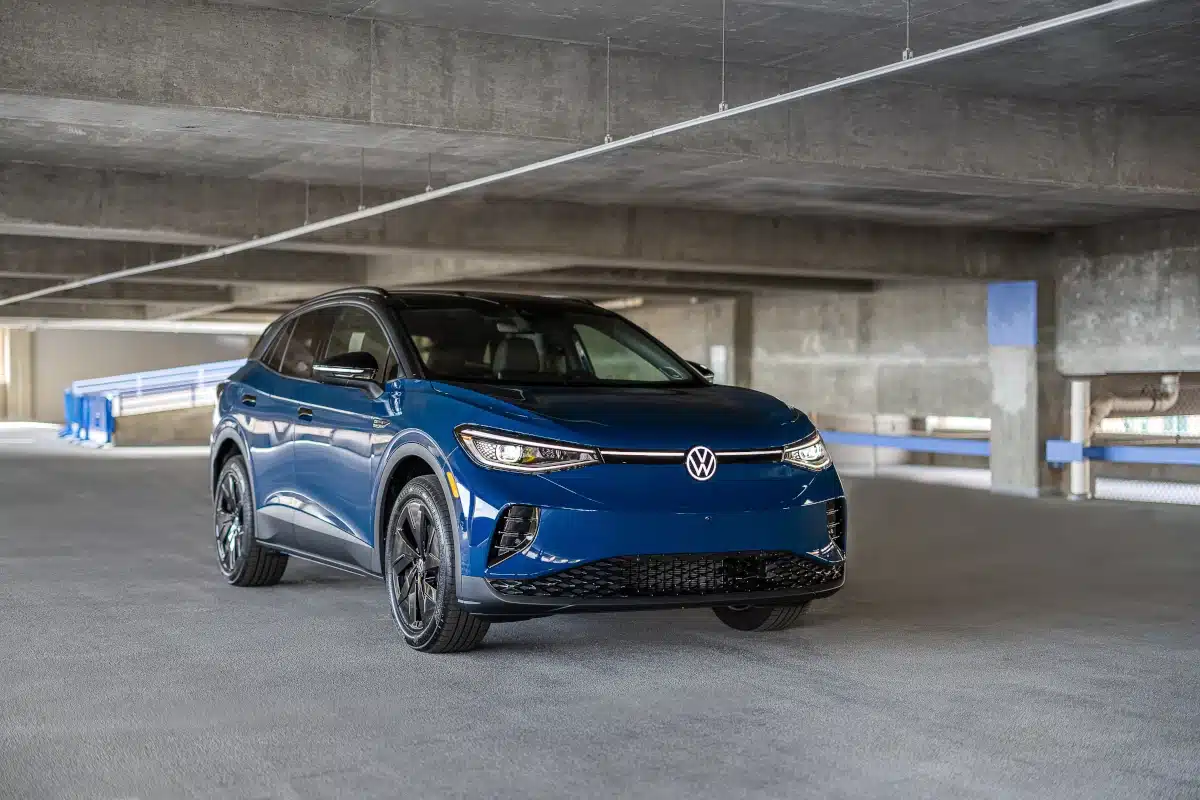
Volkswagen is recalling 22,524 model-year 2023-2026 ID.4 vehicles because their high-voltage batteries may fail and cause a vehicle fire.
Owners of affected vehicles should limit charging to 80% until the recall repair is completed. Volkswagen has not yet identified a final repair. The charging limit is an interim risk-reduction measure, according to its recall report filed with NHTSA.
Volkswagen Group of America, Inc. (Volkswagen) is recalling certain 2023-2026 ID.4 vehicles. The high voltage battery may fail and lead to a vehicle fire.
Affected VINs should be searchable now at the NHTSA website.
Here is the relevant information from the NHTSA Recall notice:
NHTSA ID Number: 26V630
Manufacturer: Volkswagen Group of America, Inc.
Components: ELECTRICAL SYSTEM
Potential Number of Units Affected: 22,524
Estimated percentage with defect: 0.1%
Descriptive Information
The recall population was determined by reviewing vehicle assembly records, high-voltage battery traceability information, supplier production records, and available vehicle charging data. Vehicles outside of this population contain cells that were produced outside the suspect range or contain cells that have sufficiently recent and complete data indicating charging usage below the defined threshold.
Description of defect or noncompliance:
The root cause is unknown, however in certain high-voltage batteries within the affected vehicle population, certain charging profiles combined with a state of charge over 80% may trigger thermal propagation within the high-voltage battery.
Description of the safety risk, including crash, fire, death, injury:
If thermal propagation occurs, it may result in a vehicle fire.
Description of the cause:
The root cause is unknown, however in certain high-voltage batteries within the affected vehicle population, certain charging profiles combined with a state of charge over 80% may trigger thermal propagation within the high-voltage battery.
Identification of any warning that can occur:
Until the recall remedy has been performed, owners are advised to limit vehicle charging to 80%. As a reminder, the vehicle owner’s manual contains important information regarding vehicle charging and setting charging settings. We encourage anyone who drives the vehicle to review the owner’s manual to become familiar with this important information.
Chronology
June 17, 2026: During ongoing review of HV battery thermal events in the field, preliminary data indicated a potential influence related to specific isolation-resistance values and DC-charging ratios. As a result, the Volkswagen Product Safety Committee ordered a field study to conduct a detailed examination of complete high-voltage battery systems from Volkswagen vehicles that had not previously been included in its previous HV battery recall campaigns.
September 21, 2026: The results available from the field study and the current field situation were presented to and discussed by the Volkswagen Group Product Safety Committee. It was observed that in certain high-voltage batteries, certain charging profiles combined with a state of charge over 80% may trigger thermal propagation within the high-voltage battery. The Committee requested additional clarifications from the battery cell supplier concerning the production measures and the potential clean date.
The Committee assigned additional analyses concerning vehicle charging behavior and the assumptions, timing, and technical implementation requirements for an interim limitation of the high-voltage battery’s maximum state of charge to 80 percent. These analyses remained ongoing.
September 23, 2026: The Volkswagen Product Safety Committee reviewed the updated field information and the additional information provided by the battery cell supplier. While the root cause of the events in the field is still unknown, based on the available technical information, the field situation, and the potential safety consequences of a high-voltage battery failure, the Volkswagen Product Safety Committee decided to conduct a voluntary safety recall for the affected U.S. vehicles.
Date of defect determination: September 23, 2026.
23 claims identified for USA from January 18, 2024 through August 07, 2026
A reimbursement plan will not be offered under this recall because the affected vehicles are within the New Vehicle Limited Warranty period.
Remedy
Description of Remedy
Remedy Type: Not stated
Description of remedy program:
The root cause and repair solution still needs to be identified. The final remedy remains under development.
As an interim risk-reduction measure, all affected owners of vehicles subject to this campaign will receive a warning sticker to be placed at specific places at the vehicle to remind operators not to charge the HV battery above 80% state of charge. Depending on the vehicle configuration and online connectivity, some vehicles may be configured to limit the maximum state of charge of the high-voltage battery to 80 percent.
How remedy component differs from recalled component:
The root cause and repair solution still needs to be identified. The final remedy remains under development.
As an interim risk-reduction measure, all affected owners of vehicles subject to this campaign will receive a warning sticker to be placed at specific places at the vehicle to remind operators not to charge the HV battery above 80% state of charge. Depending on the vehicle configuration and online connectivity, some vehicles may be configured to limit the maximum state of charge of the high-voltage battery to 80 percent.
Description of recall schedule:
Dealer/owner notifications expected on or before November 27, 2026