
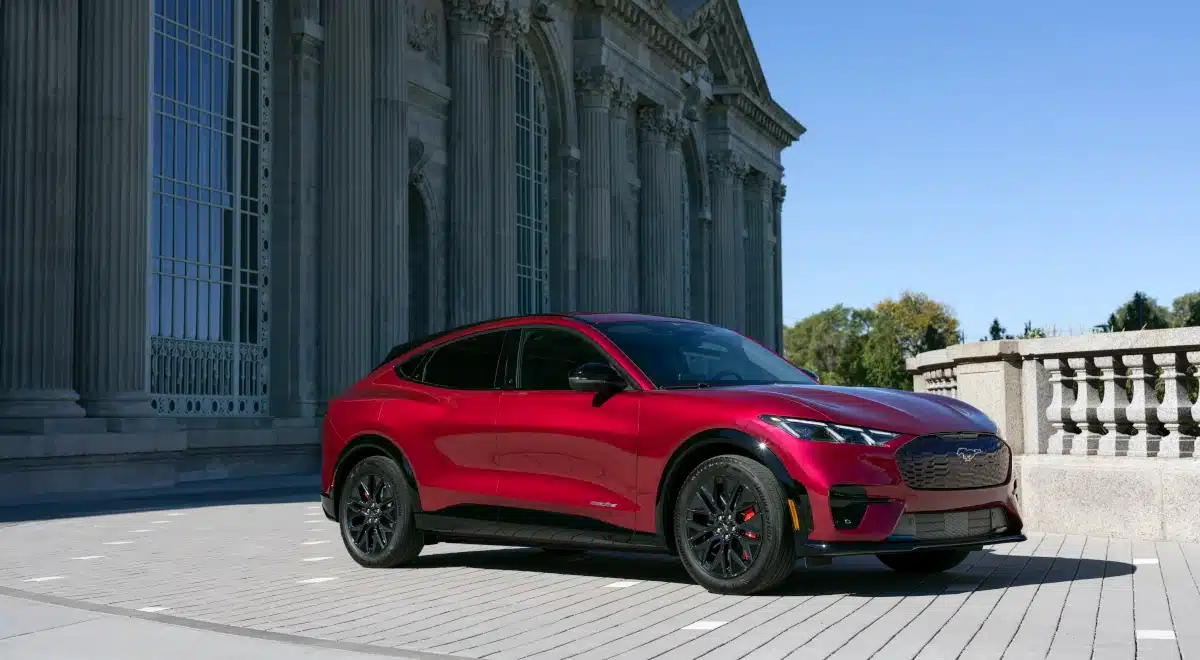
Ford is recalling 86 Mustang Mach-E vehicles because incorrect battery-control software can cause a loss of power or increase the risk of a battery fire.
Ford Motor Company (Ford) is recalling certain 2023-2025 Mustang Mach-E vehicles that received a new Battery Energy Control Module (BECM) during a prior repair. The battery energy control module software may cause an incorrect state of charge to display in the vehicle, or lead to an increased risk of a high-voltage battery fire after repeated DC fast-charging cycles.
Owners can check their vehicle identification number (VIN) on the NHTSA recall lookup to see whether their vehicle is affected.
Here is the relevant information from the NHTSA Recall notice:
NHTSA ID Number: 26V582
Manufacturer: Ford Motor Company
Components: ELECTRICAL SYSTEM
Potential Number of Units Affected: 86
Estimated percentage with defect: 100%
Descriptive Information
Ford’s team reviewed vehicle service records to determine the affected population. Affected vehicles have lithium iron phosphate (LFP) batteries and received a replacement Battery Energy Control Module during service.
These vehicles are not produced in VIN order. Information as to the applicability of this action to vehicles can best be obtained by either calling Ford’s toll-free line (1-866-436-7332) or by contacting a Ford or Lincoln dealer who can obtain specific information regarding the vehicles from the Ford On-line Automotive Service Information System (OASIS) database.
86 Mach-E vehicles are affected.
Description of defect or noncompliance:
Some vehicles may experience over-estimation of high-voltage battery state of health (SOH) following replacement of the BECM during service. An overestimated SOH will cause the vehicle to display an artificially high State of Charge (SOC) in its instrument panel cluster. Additionally, an overestimated SOH may result in increased lithium plating of the vehicle’s high-voltage battery cells as the number of DC fast-charging (DCFC) cycles increases over the vehicle’s lifetime.
Description of the safety risk, including crash, fire, death, injury:
A displayed SOC that is higher than the actual SOC can result in unexpected power limitation and an eventual loss of motive power. A loss of motive power may increase the risk of a crash. Severe high-voltage battery cell lithium plating increases the risk of battery thermal venting, potentially resulting in a vehicle fire.
Description of the cause:
Newly installed BECM service parts were initialized to 100% SOH rather than inheriting the true SOH of the vehicle’s high-voltage battery pack.
Identification of any warning that can occur:
The customer may observe the illumination of warning indicators, specifically a wrench light or turtle light in the instrument panel cluster, as the vehicle experiences power limitation.
Chronology
On July 7, 2026, Ford’s Critical Concern Review Group (CCRG) opened an investigation into Ford’s Electrified Propulsion Engineering (EPE) team’s identification of an issue in which Mustang Mach-E vehicles equipped with Lithium Iron Phosphate (LFP) batteries may experience battery State of Health (SOH) overestimations following a Battery Energy Control Module (BECM) replacement in service.
Between July and August 2026, Ford analyzed warranty claims and part sales records to identify vehicles that had received a BECM replacement. Upon reviewing connected vehicle data, the investigation team determined that a newly installed BECM initializes at 100% SOH by default and fails to inherit the actual battery SOH data from the replaced module. The investigation team also worked to better understand potential effects of an overestimated SOH on the vehicle.
During the investigation, Ford also identified an additional population of BECM parts sold over-the-counter or installed as warranty replacements, which could cause the same condition.
As of August 20, 2026, Ford is aware of one warranty report, one Global Contact Center Technology (GCCT) customer report, and two Global Common Quality Indicator System (GCQIS) reports related to BECM replacements. Ford is not aware of any field reports specifically related to the SOH overestimation condition.
On September 1, 2026, Ford’s Field Review Committee reviewed the concern and approved a vehicle and equipment field action.
Ford is not aware of any reports of accidents, injuries, or fires related to this condition.
Remedy
Description of Remedy
Remedy Type: Repair, Software
Description of remedy program:
Owners will be notified by mail and instructed to take their vehicle to a Ford or Lincoln dealer to have the BECM software updated using the Ford Diagnosis and Repair System (FDRS). There will be no charge for this service.
How remedy component differs from recalled component:
The updated BECM software (PZ98-14C197-K) integrates a new data migration protocol to ensure the module inherits the existing battery’s actual SOH rather than defaulting to 100%.
Description of recall schedule:
Notification to dealers is expected to occur on September 9, 2026. Mailing of interim owner notification letters is expected to begin October 26, 2026 and is expected to be completed by October 29, 2026. Mailing of remedy owner notification letters is expected to begin December 28, 2026 and is expected to be completed by December 31, 2026. The date VINs are planned to be searchable is September 9, 2026.